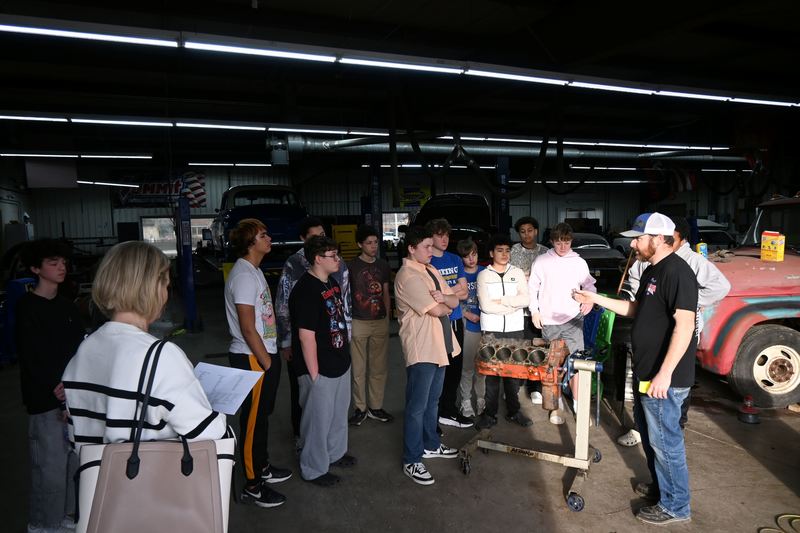
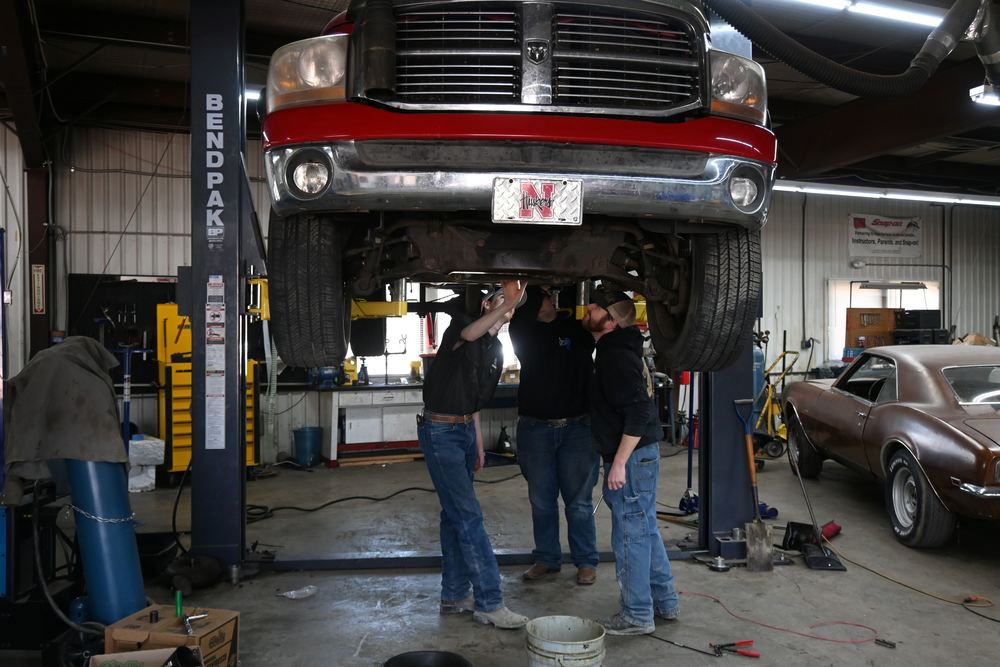
When J.R. Keene unlocked the garage doors at Parsons High School for the first time, he had a passion for automotive work, experience and a vision — but no background in K-12 education or roadmap.
“There wasn’t a day-to-day curriculum laid out. It was like, ‘Here’s a set of keys. Here’s your shop. Here’s your classroom. Best of luck,’” Keene said of stepping into the automotive program after it had been overseen by a full-time substitute the last 3 ½ years. “I struggled with that my first few weeks, being an inexperienced teacher and being inexperienced in classroom management."
During the summer, before students ever walked in, Keene cleaned, sorted and inventoried the space now known as the Viking Speed Shop. What he quickly realized was that he wouldn’t just be teaching — he would essentially be building the program from the ground up, while also educating himself.
Regardless of the challenges, he has met them head on and has adapted quickly to his new position.
Keene treats the class like a working shop because that’s exactly what he wants it to be — industry driven - despite not having all the industry tools at his disposal. The automotive industry changes rapidly. Manufacturers use proprietary systems schools don’t usually have access to. Therefore, instead of focusing solely on specific technologies, Keene emphasizes critical thinking, problem-solving and work ethic.
“We are working on things so kids get experience with what they’re actually going to need," he said. 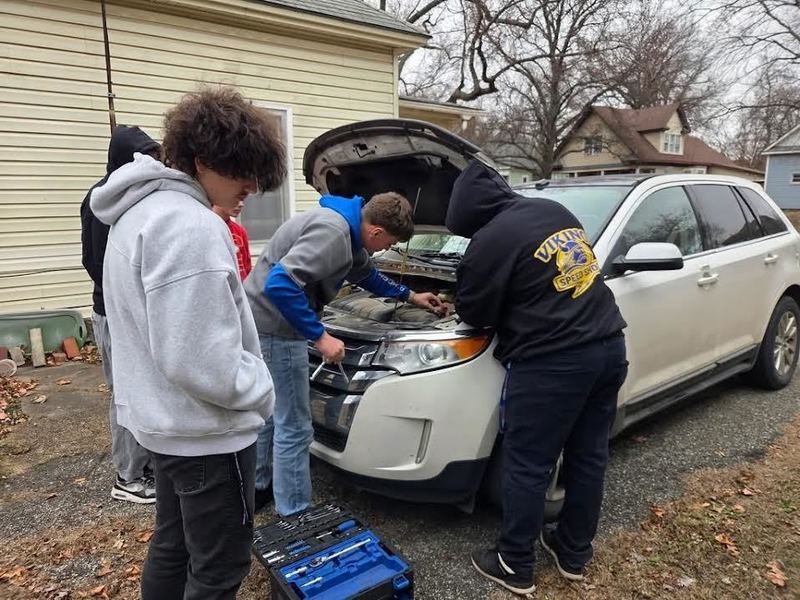
In the PHS Viking Speed Shop, that includes projects many high school auto programs wouldn’t attempt. For example, students are currently finishing an engine replacement on a truck — a job that would take about 17 labor hours in a professional shop but can stretch into weeks in a classroom setting.
“If I can do it myself in an hour or two, it takes me almost a week to teach it,” Keene said. “We’re working on a lot of things I don’t think most high school shops do, because time is (our) enemy here.”
Still, he believes it is worth it because students are learning how and why systems work — not just how to swap parts
“I think the truck’s been here for about six weeks and I think this week maybe it can leave. It worked out better than I thought it would,” he said.
While the shop often works on older vehicles, Keene emphasizes that the mechanical principles remain the same.
“If you understand how a braking system works on a 1952 Plymouth, you can understand how it works on a 2025 GMC,” he said. “We’re still moving fluid to create a clamping force. The technology changes, but the principles don’t.”
Keene tries to ensure what he is teaching is beyond the more mundane daily mechanics of a shop, in order to keep students interested and involved.
“We’ve done some after market stuff. We’ve lowered some vehicles, done some engine swaps, and done some exhaust stuff. I don’t think that’s things you would typically see out of a high school auto shop, but I think it’s stuff that keeps them interested, keeps them excited and keeps them coming back because the feeling I got from some of the students is they feel they are just working for free,” Keene said. “I get that, everybody’s time is worth something. And there are days where you don’t want to change a part that’s difficult or do something that is not exciting, but that’s going to be part of any industry they work in. There is going to be something you don’t want to do, or something that is not exciting and so if you can work through that and still make it happen, I think that’s important.”
Even for students who don’t pursue automotive careers, his class provides lifelong skills. Being able to change oil, service brakes or replace a battery when money is tight and you can’t afford to pay someone else is vital.
“That’s how my dad got me started,” Keene said. “Before we could drive, we had to learn how to service brakes and change our oil. He just wanted us to have the ability.”
Perhaps the most visible symbol of the program’s development this year is the Viking truck — a hybrid project that matches Parsons High School’s mascot.
“That truck came from a friend of mine. He talked about, ‘Hey if you need something to work on, I’ll find you something to work on.’ I was actually in this classroom working on some stuff, cleaning things out and I found these,” Keene said, laying two “Viking” metal name plates off a late 50s early 60s Chevrolet Viking on his desk. “I remembered my friend had sent me some photos of some older trucks that he had and there was a Viking. So that obviously makes sense, because we are the Vikings here at Parsons. He gave us the cab and the front of it. We bought a 2005 GMC chassis from him.”
Students are marrying the two into one functional, modernized vehicle that when complete will hopefully be equipped with fuel injection, air conditioning and cruise control.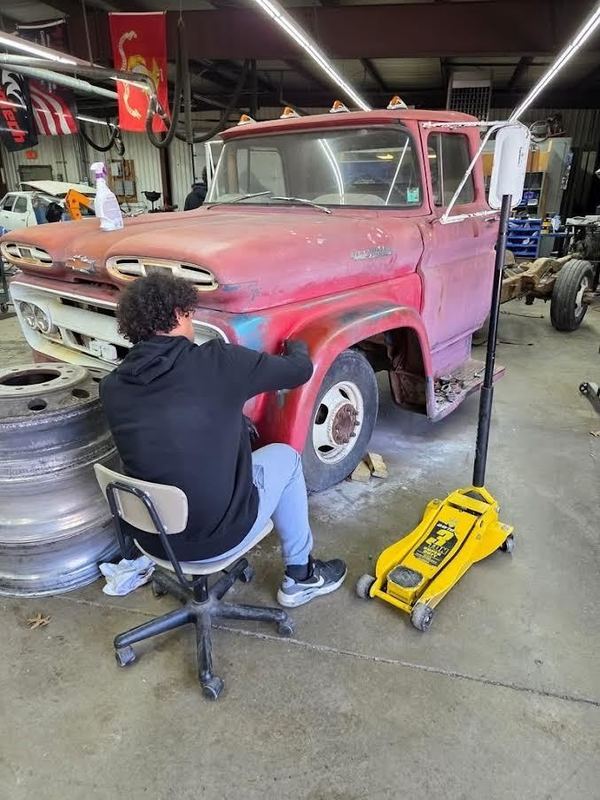
“When we’re done, it’s something tangible our CTE department can point to and say, ‘ If you come here and take these classes, this is what you’re going to have the ability to do, hopefully, when you’re done,” Keene said.
The truck project, and some others underway, also reflect something unique about Parsons’ CTE programs: cross-collaboration.
For example, when students working on a 1952 Plymouth couldn’t find a 75-year-old turn signal lens anywhere for purchase, they walked across the parking lot to the drafting department. A student created a CAD file and 3D-printed the lens. For deteriorated door panels, another drafting student designed replacements that will be cut by Jim Gilpin’s woodworking students using the carpentry shop’s CNC router.
“There’s not a lot of high schools where you can walk across the road and say, ‘Hey, can you make this?’ and they say, ‘Sure,’” Keene said. “That’s been awesome.”
Students taking automotive classes have the chance to learn much more than mechanics from Keene. While students learn engine swaps, exhaust systems and suspension modifications — projects that keep them excited and engaged — Keene says the real goal goes deeper.
“I reached out to people on my advisory committee and asked what they’d rather have — someone already trained or someone ready to learn,” he said. “A lot of them said they’d rather train someone with critical thinking and problem-solving skills and good work ethic.”
So those are the skills he is helping students hone.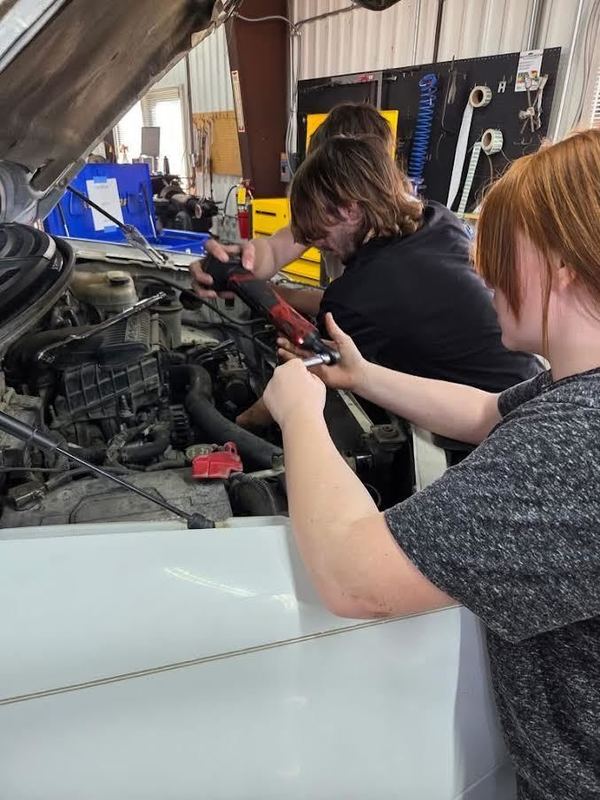
Next year, he also hopes advanced students will begin communicating directly with customers — explaining repairs, ordering parts and practicing professional interaction. He is encouraging beginning students to take business and public speaking classes.
“You have to be able to explain what’s wrong to someone who has no idea how a vehicle works,” he said. “Good communication skills apply to any industry.”
The shop frequently works on student and faculty vehicles, providing a convenient resource while giving students hands-on experience. Still, Keene is clear: the program is not meant to replace local automotive businesses.
“I don’t want anybody to think we’re a replacement for shops in the community,” he said. “ I want people to keep supporting them because I need a place for these students to go when they leave here. It is an industry that is in need.”
Keene credits strong administrative backing, community support and collaboration and strong support from fellow instructors for the program’s progress.
“If we need equipment or tools, they’ve made it happen,” he said. “There have been days I didn’t know if I could do this, and there’s always somebody willing to help.”
As his first year moves quickly toward its final months, Keene is already thinking about refinements — better time management, smoother operations and more collaboration opportunities.
“It’s been a whirlwind,” he said. “I’ve learned a lot. There are things we can do differently to help the shop run more efficiently.”
If the steady hum of activity in the Viking Speed Shop is any indication, Parsons High School’s automotive program will not just be running — it’s going to be gaining momentum.