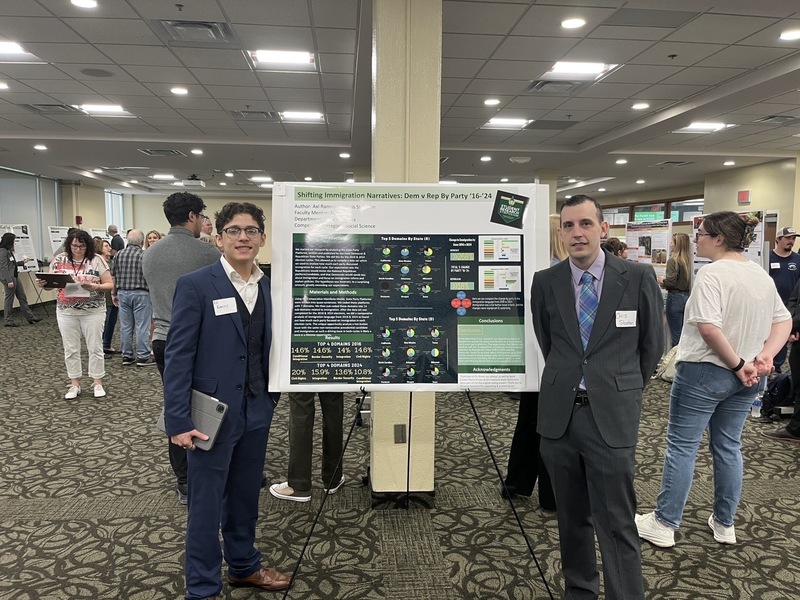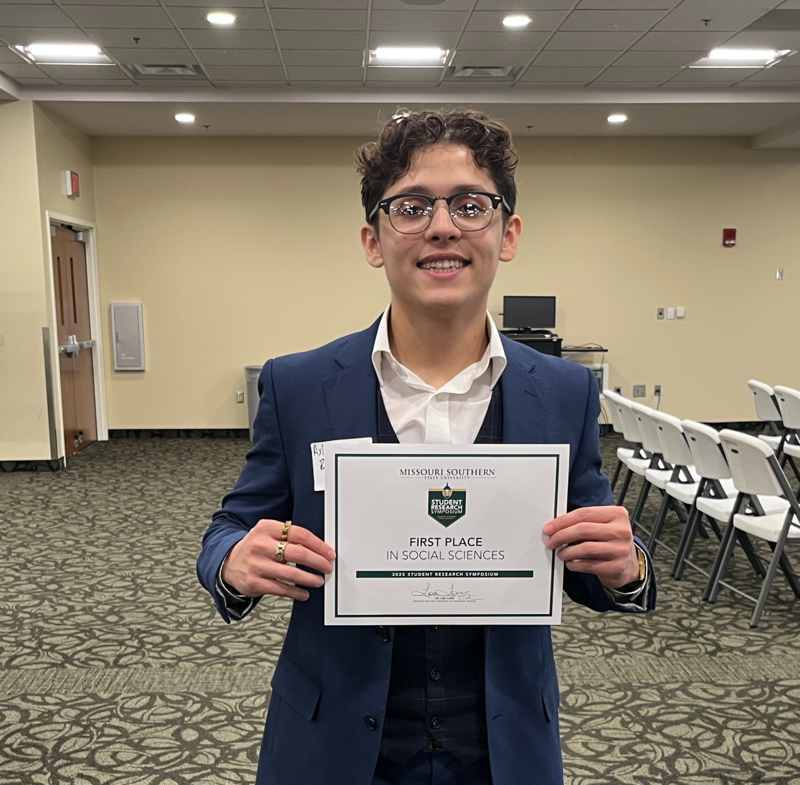

From an early age, Axl Ramirez had a clear vision for his future — and he has worked steadily, and strategically, to reach it.
Ramirez graduated from Parsons High School in May 2023. Just two and a half years later, in December 2025, he earned his bachelor’s degree in international and political affairs from Missouri Southern State University.
He was able to accelerate that timeline thanks to the partnership between Parsons High School and Labette Community College, which allows students to earn dual and concurrent credit. By the time he walked across the stage at PHS, Ramirez had already completed roughly 32 to 33 college credit hours — enough to begin Missouri Southern technically as a sophomore and jump straight into upper-level coursework.
“I think my first semester I was taking upper-level courses instead of being bogged down with general education classes,” Ramirez said. “I was able to get that out of the way and then come here and focus entirely on what my major was. I tell everybody I know from Parsons to take as many college-level courses as they can because it’s a lot cheaper and it gets you through really fast. Huge props to Parsons for that.”
Once in college, Ramirez realized he could use that same momentum to move even further ahead.
“I was taking as many credits as I could, and then I found out about a dual master’s credit program,” he said. “When I found out about it, I hopped right on it.”
The following summer after his first year, he began taking graduate-level courses that counted toward both his undergraduate and future master’s degrees — an opportunity not available to every student.
“Every single time I went to take a graduate course, I had to petition the college to apply them to my undergrad,” he explained.
Although he completed his bachelor’s degree in December, Ramirez is already nearing completion of his master’s. He is currently finishing a graduate course and working on his thesis, which he expects to complete by December 2026.
“If I hadn’t done the master’s, I would have graduated when I was freshly 20 or maybe even still 19,” he said. “When I found out about the program, I thought it would look good on my resume, give me more experience and help me be a little older when applying to law schools. It also felt like a good fallback plan if law school was too expensive or I didn’t end up going.”
Law school, however, has long been the goal.
“I’ve always wanted to go to law school. Being a lawyer has always been my end goal,” Ramirez said.
While finishing graduate work, he is also substitute teaching in the Joplin and Carthage school districts to help pay for college — and studying for the Law School Admission Test, or LSAT.
Recently, he was awarded an MSSU–7Sage LSAT Prep Scholarship. Missouri Southern partners with 7Sage, a well-known online LSAT preparation program that offers a structured, three-month course designed to improve test scores.
“It’s not a huge scholarship, but it’s really, really helpful,” Ramirez said.
LSAT scores play a major role in both law school admission and scholarship offers. Many schools require scores in the 150 to 155 range for admission. A score above 160 is considered competitive and places test takers in roughly the top 25 percent. Scores of 170 or higher place students among the top few percent nationally and can significantly increase scholarship opportunities.
“The higher the LSAT score, the more financial aid,” Ramirez said. “At the end of the day, I’m sure I’ll end up with some debt because law school is expensive, but I want to get as much financial help as I can.”
LSAT testing dates are scheduled throughout the academic year, typically every other month. Ramirez plans to take his first exam in April and is registering for a second attempt in June.
“My first test in April is just feeling it out a little bit,” he said. “Your first score is usually your worst one, so that’s why I’m going ahead and registering for a second one two months later.”
Students may take the LSAT up to seven times in their lifetime, with additional limits on attempts within a single testing year and five-year period.
As for where he hopes to attend law school, Ramirez is still weighing his options. He noted that the University of Kansas is among the highest-ranked law schools in the region.
“I’d like to go there,” he said. “But I’ve also looked at UMKC in Kansas City.”
He chose to major in political affairs because law schools accept applicants from a wide range of academic backgrounds.
“You can go to law school with pretty much any major,” Ramirez said. “It doesn’t really matter, as long as you get a good enough score on your LSAT. I figured I’m going to do what’s going to help me the most.”
While he hasn’t fully settled on a legal specialty, he does have interests.
“I know I would like to at some point have an immigration law practice,” he said. “Coming out of law school, I’ll probably do whatever seems the most promising. There are a lot of fields that are either oversaturated or not very profitable. But once you’re in law school, they have clinics where you can try different areas and see what you like.”
One aspect of law has always appealed to him.
“Since I did debate in high school, what always attracted me to being a lawyer was litigation — being in a courtroom and going to trial,” he said. “But I’m not very big on the paperwork aspect of it.”
For Ramirez, the path has always been clear: set the goal, build the plan, and move forward with purpose. And if his track record is any indication, he’s right on schedule to accomplish what he has set his sights on.